
How to talk to your child about online safety without pressure | CyberNanny
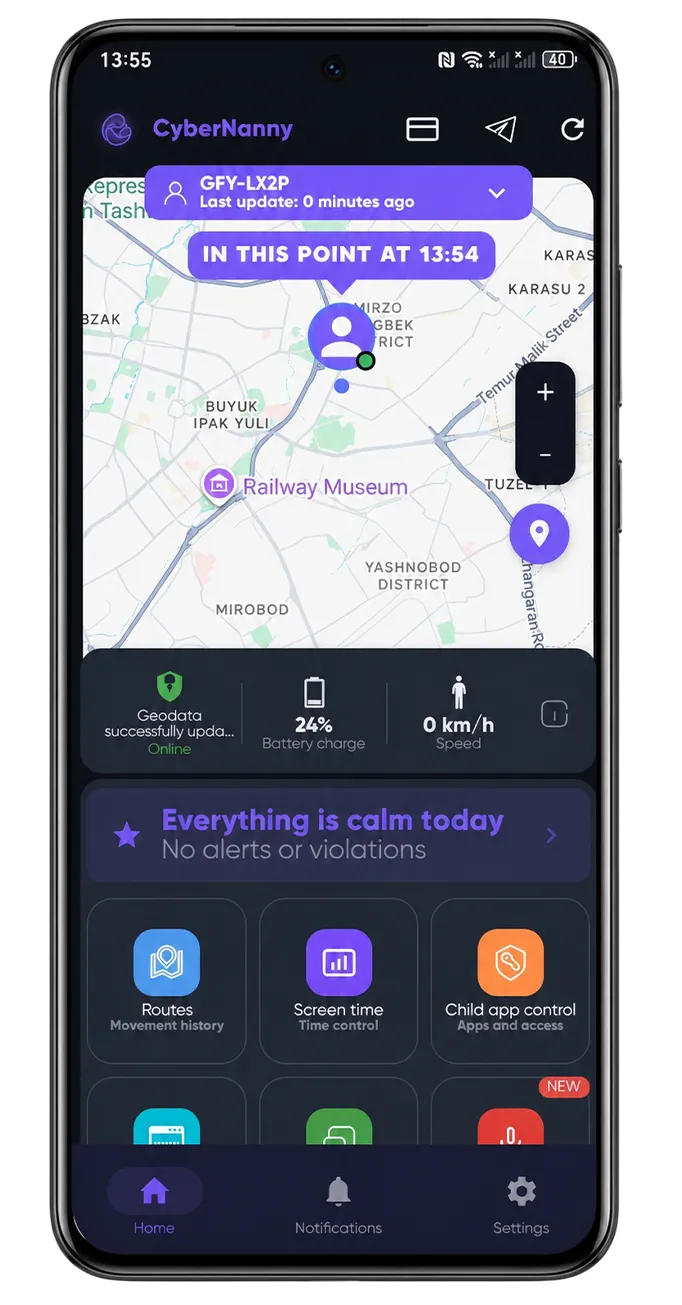
How to talk to your child about online safety without pressure — one of the most important conversations modern parents need to have with their teenagers. Technical settings and parental control apps cover part of the threats, but without the child’s own understanding of why certain actions are dangerous — they will commit them sooner or later. The main task is to teach your child critical thinking about the digital space.
This article covers how to structure the conversation so that your child actually listens, understands, and applies what they hear. Without moralizing, scare tactics, or lectures. And how CyberNanny can become a useful foundation for such conversations.
Why «direct lectures» don’t work
When a parent sits the teenager down and says «Listen, the internet is dangerous, don’t talk to strangers», the child:
- Stops listening within 30 seconds.
- Treats it as a formality («another lecture»).
- Considers themselves smarter («nothing like that will happen to me»).
- Hides real problems to avoid hearing it again.
What works better is partner-style dialogue based on concrete situations.
Principles of effective conversation
1. Concrete stories instead of general rules
«There are scammers on the internet» — empty words. «Remember that boy from a neighboring city who transferred 50,000 rubles to a scammer? It was on the news» — this works.
Use real news stories, peer cases, situations from school.
2. Ask questions, don’t teach
«What would you do if…» — this format engages the child in dialogue. «What would you do if a stranger messaged you and asked for a swimsuit photo?»
Listen to the answer. If you don’t like it — clarify, don’t criticize.
3. Share your own experience
«You know, I got a phishing message today. Do you ever get those?» — removes distance. The teenager realizes you face the same things.
4. Don’t criticize platforms or your child’s interests
«This TikTok of yours is garbage» guarantees the conversation will end. Better: «What do you like to watch? Tell me, I’m not very familiar with it.»
5. Acknowledge that you don’t know everything
If your child explains something about games, memes, or social networks — that’s normal. Parental digital competence is not «knowing better than the kid» but «being able to discuss».
Topics you must cover
Personal data
«What information about yourself can be shared online, and what should never be?» Together, create a «list of taboos»: home address, school, daily route to school, photos in school uniform (where the patch is visible), parents’ phone numbers.
Strangers in chats
«If someone you don’t know writes to you — what should you do?» Correct answer: don’t respond immediately, tell parents, block if they ask for something strange.
Intimate photographs
A difficult topic, but mandatory. Explain without moralizing: intimate photos sent «only to your boyfriend» often end up being shared. Screenshots, leaks, blackmail — these are real risks.
Fake giveaways and scams
«You won an iPhone, click here!» — even adults fall for this. Explain how to recognize fraud.
Cyberbullying
«What do you do if someone in the school chat starts insulting you? What if you see someone else being bullied?» Discuss the protocol: don’t respond with aggression, save screenshots, tell parents and/or the homeroom teacher.
Screen addiction
«How many hours a day do you spend on your phone? How do you feel if it dies during a walk?» Through these questions, the teenager will start noticing their own dependency.
Age-specific approaches
Preschoolers (4-6 years)
Simple rules in game form. «If a stranger uncle in a window in a cartoon offers to be friends — what do we do?» — «Close it!»
Younger schoolchildren (7-10 years)
Concrete stories and scenarios. «Remember the cartoon we watched together where…» Actively use real-life examples.
Middle schoolers (11-13 years)
Partner dialogue. Listen to their opinion, share yours. Discuss cases from news and school.
Older teens (14-17 years)
Serious topics — sexting, financial fraud, political manipulation in social networks. The conversation level is almost like with an adult.
How to use CyberNanny data in conversation
CyberNanny collects information about your child’s digital activity. This can be used for meaningful conversations — but carefully:
- Don’t «catch out» the child. Not «I saw what you wrote yesterday — what does this mean?»
- Use the general picture. «I noticed you communicate a lot with one girl. Will you tell me who she is?»
- Only react to alarming signals. CyberNanny’s AI Advisor flags signs of bullying or manipulation — that’s a reason to talk.
- Maintain trust. Transparency about the fact of monitoring is the main condition.
Common parental mistakes
- «Once and for all». One conversation doesn’t work. This is a process spanning years.
- Banning instead of discussing. «I told you not to, end of discussion» — guaranteed to lead to secrecy.
- Using fear. «You could be kidnapped/killed/raped» — creates neurosis, not critical thinking.
- Double standards. If parents themselves spend 8 hours a day on TikTok — no rules for the child will work.
- Lectures instead of dialogue. The teenager immediately turns off «listening mode».
Frequently asked questions
At what age should I start the conversation? From the moment the child first uses a smartphone — usually 7-9 years old.
What if my teenager refuses to discuss? Don’t push. Use «casual» pretexts — news, friends’ stories, movies.
Do schools help teach children digital safety? Partly. But family example and discussion at home matter more than school lessons.
How often should I have these conversations? Not «on schedule» but on occasion. Whenever there’s a fitting situation — news, real-life example, story.
What if my child has already made an online mistake? Don’t punish immediately — discuss. «What happened? What did you feel? What would you do differently?»
Get support through CyberNanny
Sign up at thecybernanny.com and install the app. The AI Advisor will help spot warning signs that become great starting points for meaningful conversations with your child — without scandals, in partner-dialogue format.