
Preschoolers and Gadgets: What Parents of Toddlers Should Know
Phones and tablets have become part of everyday life, and preschoolers notice this very early.
Many parents ask themselves: is a phone safe for a child? What about children at 3, 4, or 5 years old?
Should gadgets be forbidden, limited, or used in a “smart” way?
This article is for parents of toddlers and preschoolers who want to understand how gadgets really affect young children and how to use them without stress, fear, or constant conflicts.
Why gadgets attract preschool children so much
Bright colors, fast animations, sounds, and instant reactions — gadgets are designed to capture attention.
For a young child, this is especially powerful. The brain of a toddler is still developing, and screens stimulate it much faster than toys, books, or real-life interaction.
This does not mean that gadgets are “evil”. The problem starts when a phone replaces communication, play, movement, and rest.
Children 3 years old and phones
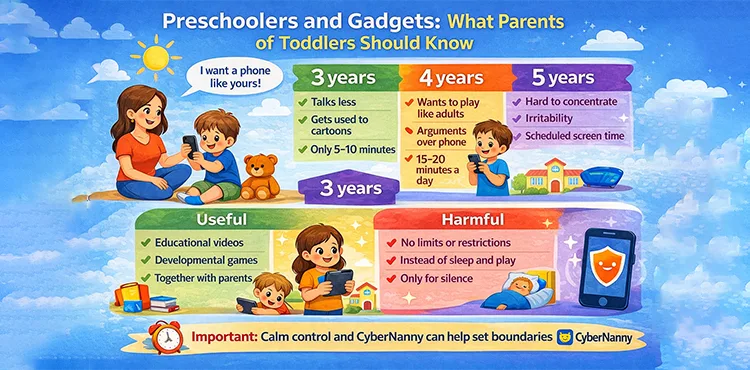
At the age of three, a child is actively developing speech, attention, and emotional connection with adults.
When a phone appears too often, parents may notice that the child:
- talks less and reacts worse to speech;
- quickly gets used to cartoons;
- calms down only with a screen.
For children 3 years old, phone use should be very limited — usually no more than 5–10 minutes at a time, and always with an adult nearby.
The screen should never replace conversation, reading, or play.
Children 4 years old and phones
At four years old, children begin to copy adult behavior.
That is why many parents hear: “I want a phone like yours.”
This age often brings conflicts around gadgets.
Common situations parents face:
- arguments when the phone is taken away;
- requests to play “like adults”;
- difficulty stopping screen time.
For children 4 years old, phones can be used a bit longer — about 15–20 minutes a day — but clear rules are very important.
It helps when screen time happens at the same time every day and does not depend on tantrums or requests.
Children 5 years old and phones
At five years old, a child is already preparing for school.
Attention, self-control, and the ability to focus become very important.
Uncontrolled gadget use can lead to:
- difficulty concentrating;
- irritability and mood swings;
- problems falling asleep.
For children 5 years old, gadgets should be used by schedule, not spontaneously.
Educational games and videos can be useful, but only if they do not replace outdoor play, sleep, and communication with family.
Gadgets for toddlers: useful vs harmful
When gadgets can be useful
- educational videos watched together with parents;
- simple developmental games appropriate for age;
- short screen sessions with explanation and discussion.
When gadgets become harmful
- no limits or time restrictions;
- screens instead of sleep, walks, or meals;
- phones used only “to keep the child quiet”.
A gadget should never be the main tool for calming a child.
If a phone is always used for silence, the child does not learn to cope with emotions in other ways.
How to set rules without shouting or punishment
Preschool children do not understand abstract bans, but they understand routines.
Simple rules work best:
- clear time limits explained in advance;
- no screens before sleep;
- gadgets are not a reward or punishment;
- parents follow the same rules.
When rules are calm, consistent, and predictable, children accept them much easier.
A small helper for parents
Many parents find it hard to control screen time manually every day.
That is why parental control applications exist.
For example, tools like CyberNanny can help parents set limits, manage schedules, and reduce conflicts around gadgets.
Such apps are not a replacement for parenting, but they can be a useful assistant — especially when you want boundaries without constant arguments.
🌐 Official website
📡 Official Telegram channel
Conclusion
Phones and gadgets are part of modern childhood, even for preschoolers.
The key is not prohibition, but balance.
When parents understand the needs of children at 3, 4, and 5 years old, gadgets stop being a problem and become just one small part of life — not the center of it.