
Protecting Children from Unwanted Online Content: Blocking and Monitoring | CyberNanny
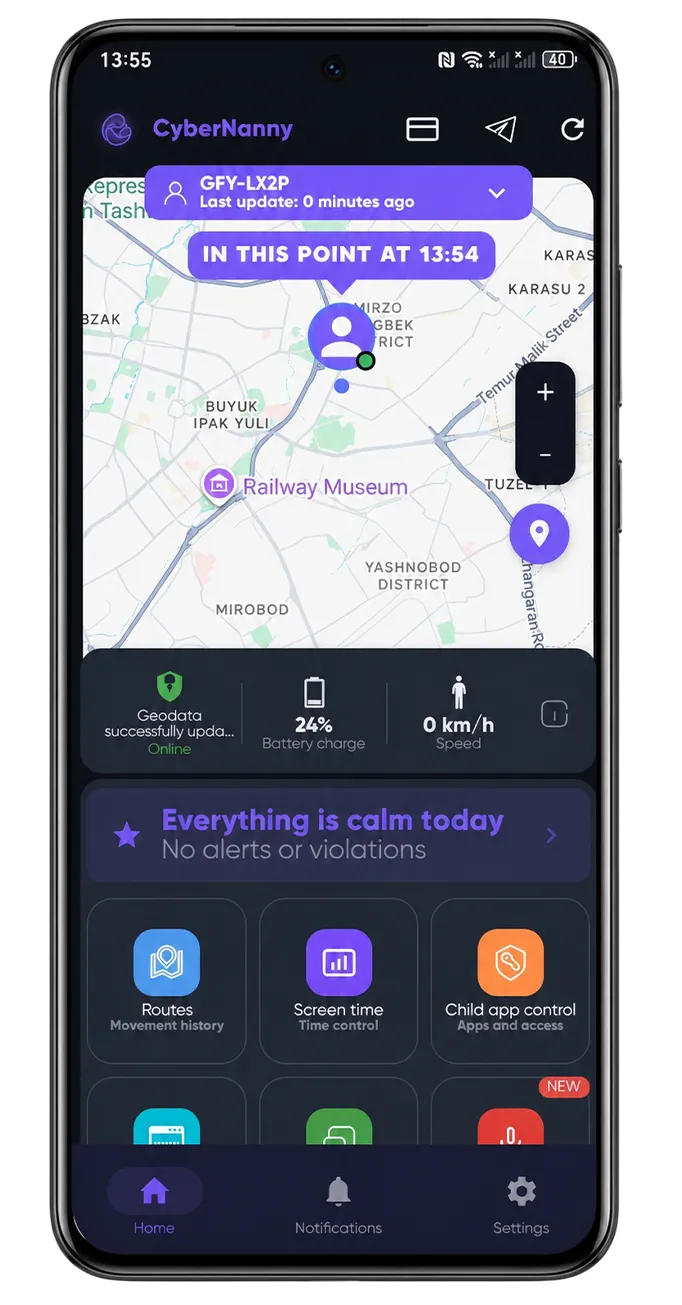
Protecting children from unwanted online content: blocking and monitoring. The modern internet exposes children to enormous amounts of information, much of which is inappropriate for their age. Pornography on YouTube, violence in games, extremist content on social networks, «harmful challenges» in TikTok — all of this is accessible to a child within a couple of clicks if no protection is configured.
This article covers methods to block unwanted content at the device, browser, and network level — and how the CyberNanny app helps see when blocking has been bypassed.
Multi-layer protection — best approach
No single solution covers all threats. Effective protection combines multiple layers:
- Device level — Android settings, iOS Restrictions, Family Link.
- App store level — age ratings in Google Play and App Store.
- App level — Restricted Mode in YouTube, Instagram restrictions.
- Browser level — SafeSearch, parental controls in Chrome.
- Network level — DNS filters on the home router.
- Monitoring level — parental control programs.
Each layer plugs gaps in the others.
Layer 1: Family Link from Google
The simplest way to set parental control on Android:
- Install Family Link on your phone and your child’s phone.
- Link the devices via the child’s Google account.
- Set age ratings for apps in Google Play.
- Enable mandatory SafeSearch in Google search.
- Set time limits and bedtime hours.
The downside: tech-savvy teenagers can find ways around Family Link. Also, you need to know the child’s Google password.
Layer 2: Restrictions in YouTube
YouTube is one of the main sources of content for children. To make it safer:
- For younger children (under 12) — install YouTube Kids, a separate app with deep filtering.
- For teenagers — enable «Restricted Mode» in regular YouTube (Settings → General → Restricted Mode → On).
Lock these settings via PIN code so the child can’t disable them.
Layer 3: SafeSearch in Google
To prevent search results from showing adult content:
- Open google.com/safesearch in the browser on the child’s phone.
- Enable «Hide explicit content».
- In Family Link lock this mode — child can’t disable.
SafeSearch isn’t perfect, but blocks 90% of accidentally encountered porn content.
Layer 4: blocking via DNS filter
The most reliable way at the network level. DNS server blocks access to categories of sites regardless of device settings:
- Cloudflare 1.1.1.1 for Families (DNS 1.1.1.3 / 1.0.0.3) — blocks malware and adult content.
- OpenDNS Family Shield (208.67.222.123 / 208.67.220.123) — blocks «Adult», «Tasteless», «Proxy/Anonymizer» categories.
- AdGuard DNS (94.140.14.15 / 94.140.15.16) — blocks ads and trackers, has a «Family» variant.
Configured at the Wi-Fi router level (covers all home devices) or directly in Android Wi-Fi settings.
Layer 5: privacy in social networks
On every social network the child uses:
- Account is private — only confirmed friends see content.
- Direct messages from strangers blocked.
- Geolocation disabled in posts and stories.
- Tagging on photos requires permission.
Walk through these settings together with your child, explaining each.
Layer 6: monitoring through CyberNanny
Even with all the blocks above, smart teenagers find ways around. CyberNanny shows what’s actually happening:
- Screen capture history — what the child sees, regardless of incognito or VPN mode.
- Browser history from all browsers on the device.
- App usage — including ones not visible on the home screen.
- AI Advisor — analyzes communications and flags concerning content.
What to block — typical list
- Pornographic sites. Massive problem for teenagers.
- Self-harm instruction sites. «Death groups» — known risk.
- Gambling games. Teenagers easily get hooked on lootboxes and microtransactions.
- Extremist forums. Recruitment of minors goes through closed communities.
- Pirated content sites. Often virus-infected.
- Anonymous chat services. Random-chat sites where the teenager may end up with adults.
What if the child uses VPN to bypass
This is a common practice. Solution:
- Block VPN app installation through Family Link.
- If VPN is already installed — see it in CyberNanny’s app monitoring.
- Discuss with the teenager — bypass attempts often signal that your control style is too strict, find compromise.
Frequently asked questions
Can I block specific YouTube channels? Through Family Link — yes, via YouTube Kids restrictions or family profile. On regular YouTube — no.
Will blocking work in incognito mode? At DNS level — yes. Through browser settings — no. CyberNanny will see the activity through screen captures.
Can I block sites only at certain times? Family Link and CyberNanny allow scheduled blocking — for example, blocking social networks during school hours.
What about iPhone? Apple’s built-in «Screen Time» has similar functions. CyberNanny for iOS is in development.
How effective is multi-layer protection? Together it covers ~95% of typical threats. The remaining 5% — when monitoring helps you notice problems and react.
Install CyberNanny
Sign up at thecybernanny.com and install the app on your child’s Android phone. The trial period is free — try monitoring and content blocking before committing to a subscription.