
Monitor Kids' Messages: See What Matters Without Reading Everything
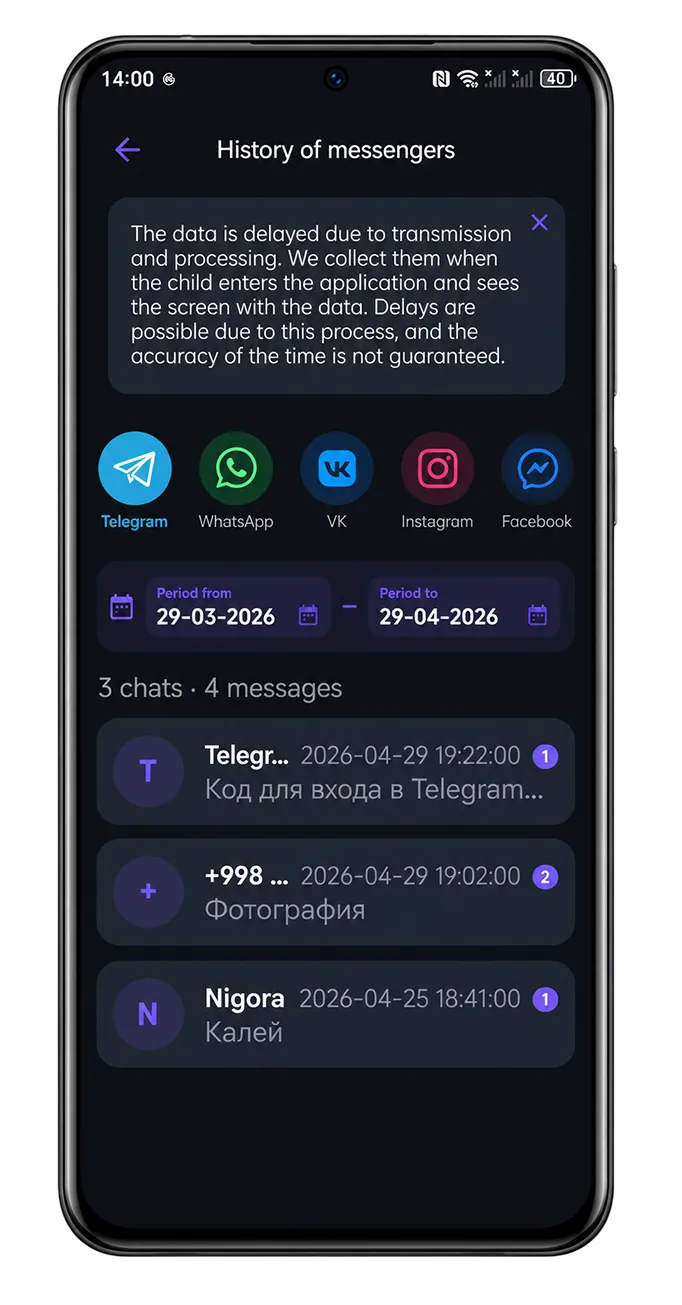
Parents almost never ask "who is my child talking to" out of curiosity. The question appears after something specific: they started hiding the screen when you walk in, went quiet after school, began receiving messages at night, or mentioned a new adult friend you had never heard about.
And that is where the trap sits. Reading every message means thousands of texts, memes and slang you will drown in by the first evening. Not reading anything means finding out last — which is exactly how bullying in class chats usually goes.
CyberNanny takes a third route: instead of making you read everything, it shows you what is worth looking at.
- Supported: WhatsApp, Telegram, Instagram, Facebook, Viber, Signal and more — text, photos and voice messages.
- The real value is not access but AI analysis: the system flags dangerous conversations and alerts you.
- It detects grooming, bullying, scammers, dangerous challenges and signs that your child is struggling.
- Full message access requires Android — iOS restricts what third-party apps may read.
- Your child knows the app is installed. Covert surveillance breaks trust and ends with a deleted app.
Why "read everything" does not work
Parents who start by reading whole conversations usually give up within a week, for three practical reasons.
Volume. An active teenager exchanges hundreds of messages a day across five or six chats. Reading that carefully is physically impossible, and reading it carelessly is useless.
Language. Half of it is memes, abbreviations and inside jokes. A line that looks threatening out of context is often a quote from a game. And the reverse is worse: a genuinely dangerous conversation looks perfectly neutral, because an adult preparing a child does not write anything forbidden — he simply becomes a friend.
The cost of being caught. If your child learns you are reading everything, the conversation about safety turns into a conversation about violated boundaries. After that they move to an app you do not know about.
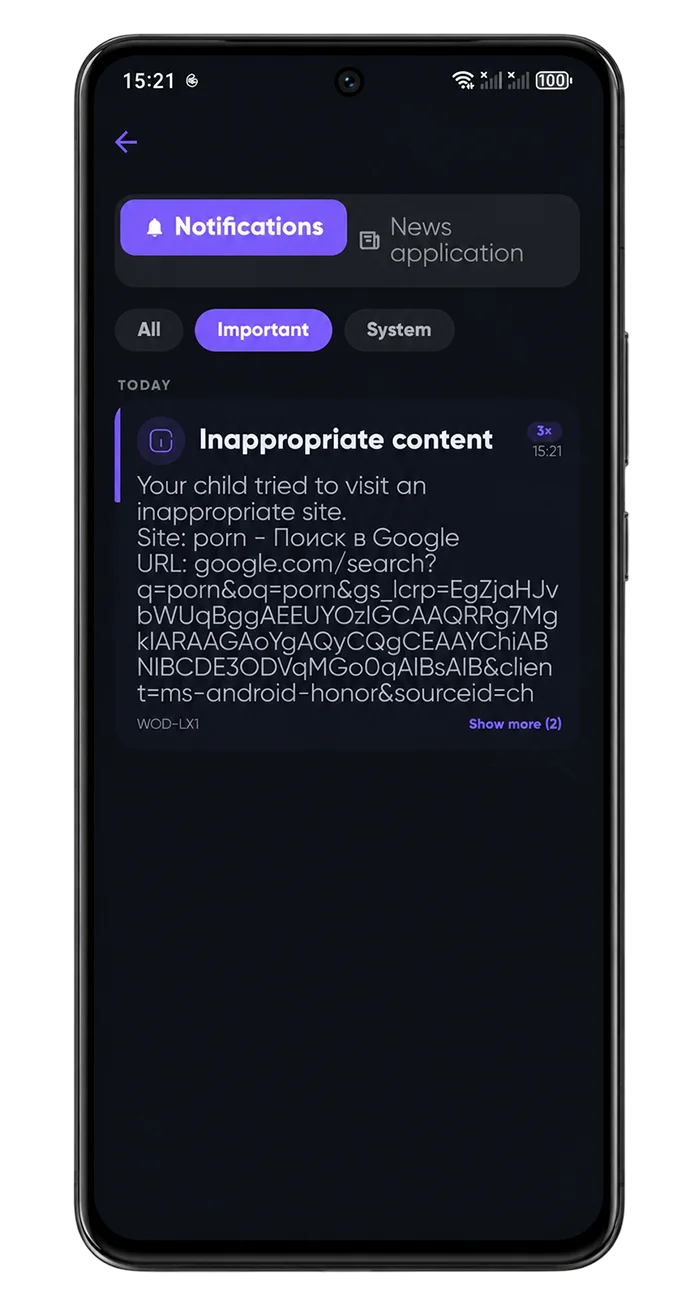
AI alerts: the system spots it first
Instead of a firehose, you get a notification when something looks wrong — not "your child sent 340 messages" but "this conversation with an unknown adult shows grooming patterns".
What the AI recognises:
- Grooming. An adult building trust: asking about family and school, complimenting, offering secrets "just between us", suggesting a meeting. The pattern is well documented, and the algorithm sees it as a sequence rather than a single word. See grooming warning signs.
- Bullying. Systematic insults in a group chat, exclusion, threats — the thing children almost never report themselves. See cyberbullying in school chats.
- Scammers. Hacked-friend schemes, fake giveaways of in-game currency, urgent money requests. More in protecting kids from messenger scams.
- Dangerous challenges and the communities that push them.
- Warning signs about your child — language that may point to depression or self-harm.
Any alert can be marked as irrelevant, and the system adapts to how your family actually talks.
How grooming actually looks
Parents tend to imagine danger as a rude message from a stranger. In reality it looks like friendship, which is exactly why children do not recognise it.
First the adult appears in a game chat or comments, as an equal. Then comes the friendship stage: he is the one who listens carefully, remembers details, supports them when parents "do not understand". Then a shared secret — something not to mention at home. Requests for photos and a suggestion to meet come last.
The signal the AI catches and a parent skimming rarely does: an adult in a child's chat who insists on secrecy.
Try CyberNanny for free
Messenger monitoring is part of the free plan, with no time limit. Setup on Android takes two minutes.
Get the appEthics: your child knows, and that is right
We do not build an invisible mode. The reason is pragmatic: covert monitoring is discovered eventually, and the price is not one bad evening but years of lost trust. A child who finds out about surveillance does not become safer — they become better at hiding.
A workable agreement sounds like this: "I am not going to read your chats with friends. But if the app notices an adult asking you to keep secrets, I will know — because that is my job as a parent." Teenagers accept that framing, and it is honest: you genuinely are not reading everything.
FAQ
Can I read my child's messages without installing an app on their phone?
No. Messages are stored on the device and on messenger servers in encrypted form, so access is only possible through an app installed on your child's phone. Services promising "messages by phone number" are scams.
Are Telegram secret chats visible?
No. Secret chats are end-to-end encrypted and stored only on participants' devices — that is a messenger limitation. Regular chats, groups and channels are visible.
Does message monitoring work on iPhone?
iOS restricts what third-party apps may access, so full message monitoring is available on Android. On iPhone, location, screen time and other features still work.
Is it legal to read my own child's messages?
Parents and legal guardians may take reasonable steps to protect a minor child, and rules differ by country — in most places open, disclosed monitoring of your own minor child is lawful. Monitoring an adult without consent is not, anywhere.
Will my child know their messages are visible?
Yes, and we consider that correct. The app does not hide itself, and that is what makes the arrangement survive.
Is messenger monitoring included in the free plan?
Yes, message access is free with no time limit. PRO removes the mask from AI alert details and extends reports.